

CR / C01
Giving a hidden local venue the digital presence it deserves.
- UX Design
- WordPress Development
- SEO
Station TEN is an independent bar, live music and events venue that I discovered almost by accident.
I was looking for somewhere local to meet my partner and came across the venue, but there was no dedicated website to properly understand what it offered. Visiting felt like a small leap of faith.
What I found was a hidden gem: a great physical experience that simply wasn't being represented online.
A chance conversation with the owner turned that observation into a real product opportunity.
Case study
The challenge
For a local venue, the website often starts working before a customer ever walks through the door.
People want to know:
What's on? What does the place look like? What can I eat or drink? Where is it? When is it open? Can I book it?
Without a dedicated website, that information can become fragmented across Google, Instagram, Eventbrite and other platforms.
The challenge was to create a central digital home for Station TEN that reflected the venue itself while making those important customer journeys much easier.
It also needed to be realistic for a small independent business to operate.
The approach
I started with discovery rather than immediately building a website.
I looked at the venue from the perspective of a first-time customer, researched comparable hospitality and events businesses, identified the information customers would need and mapped the key journeys.
The experience was then designed mobile-first because discovery of local venues frequently happens while people are already using their phones.
The core experience brings together:
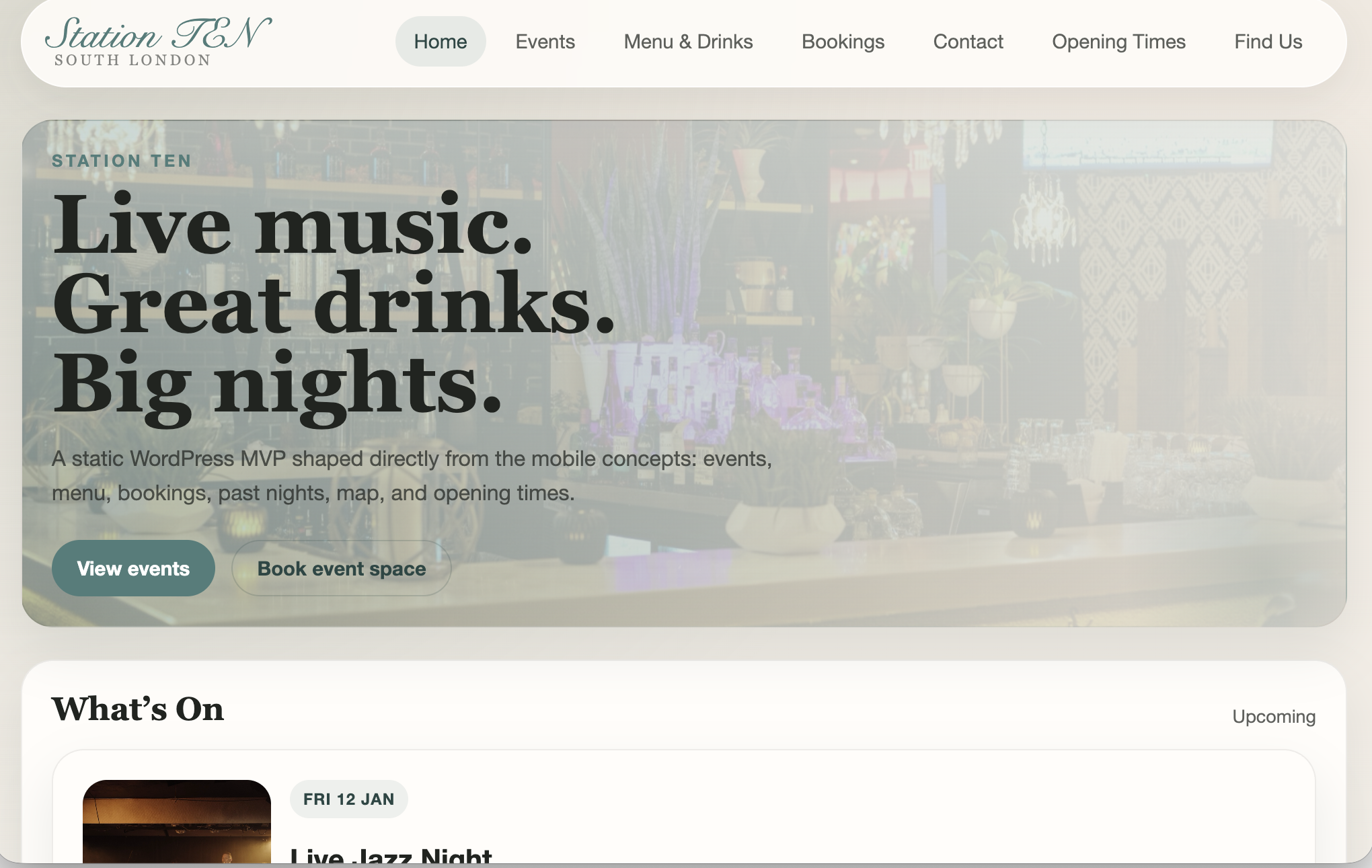
- upcoming and past events
- food and drinks
- opening times and location
- private hire
- event enquiries
- co-working
- booking journeys
- contact and social information
I developed the initial experience in Figma before moving into a working WordPress implementation.
Designing around customer intent
The site isn't organised around what pages a business traditionally thinks it needs.
It's organised around what a potential customer is trying to accomplish.
Someone discovering Station TEN should quickly be able to understand what kind of venue it is, see what's happening there and decide whether they want to visit.
Someone already interested in the venue needs a much shorter path to events, menus, directions or making an enquiry.
And someone planning a birthday, private function or event needs to immediately understand that the venue can be hired and how to start that conversation.
That thinking shaped the information architecture and calls to action throughout the site.
Building something the business can actually manage
A good small-business website shouldn't require a developer every time an event changes.
That's one of the reasons I chose WordPress.
The implementation gives the business a familiar content-management system while allowing the customer-facing experience to be designed specifically around the venue.
Content such as events, menus and general venue information can be maintained without changing the underlying site.
For the initial version, existing services such as Eventbrite can continue handling ticketing while enquiries are routed directly to the business.
This keeps the first release practical without preventing more sophisticated functionality later.
SEO from the foundation
Discoverability was one of the core problems the project was intended to solve, so SEO couldn't simply be something added after development.
I structured the site with search engines as well as customers in mind.
That includes:
- semantic page and heading structure
- descriptive page titles and metadata
- crawlable website content
- location-focused information
- dedicated event and service content
- mobile responsiveness
- performance considerations
- accessible markup and navigation
- clear internal linking
- foundations for local search optimisation
The objective isn't to make unrealistic promises about Google rankings.
It's to give the business a technically sound, search-friendly foundation from which its visibility can grow.
Designed to grow with the venue
I deliberately avoided turning the first release into an expensive custom platform.
The architecture allows the business to start with the functionality it actually needs and progressively bring more of its customer journey in-house.
A future phase could introduce:
- Direct bookings
- online payments
- customer accounts
- memberships
- member discounts
- priority event access
- booking management
That creates a progression from a marketing website into a broader digital platform without requiring the business to fund or manage all of that complexity on day one.
From design to launch
The project covers more than producing screens.
The process considers what is required to take a small business from an inconsistent online presence to a functioning website:
- Discovery
- Competitor Research
- Customer Journeys
- Information Architecture
- Wireframing
- Mobile-First UI
- WordPress Development
- Content Structure
- Booking & Enquiry Setup
- SEO Foundations
- Responsive Testing
- Launch Readiness
It means design, development and the commercial reality of running the website are considered together rather than as separate exercises.
What I learned
Station TEN reinforced how valuable it is to experience a problem from the customer's side before trying to solve it.
I didn't discover the venue because somebody handed me a design brief.
I was the potential customer struggling to understand the business online.
That made the central problem unusually clear:
The quality of the digital experience wasn't matching the quality of the real-world experience.
It also strengthened my understanding of designing for two users at once: the customer who needs an effortless experience and the small-business owner who needs something practical to maintain.
Outcome
Station TEN evolved from a chance discovery into an end-to-end hospitality website project covering product thinking, UX, design, development and SEO.
The resulting approach provides a repeatable foundation for independent bars, restaurants, cafés, event spaces and other hospitality businesses facing the same problem:
A great business shouldn't remain a hidden gem because its digital presence makes it difficult to discover.
Stack
- WordPress
- PHP
- HTML
- CSS
- JavaScript
- Figma
- UX Design
- Responsive Design
- SEO